

By: Adekunle Pafeolu
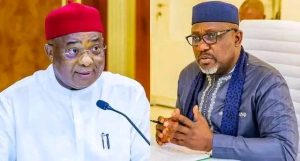
The internal political challenges confronting the All Progressives Congress (APC) have taken a fresh turn following a reported Federal High Court judgment nullifying Governor Hope Uzodimma’s emergence as the party’s candidate for the Imo West Senatorial District election and recognising former Imo State Governor Rochas Okorocha as the rightful winner of the party’s primary.
The development has added a new dimension to the political calculations within the ruling party as prominent figures navigate competing ambitions, strategic alliances and preparations for the 2027 general elections.
The dispute between Uzodimma and Okorocha, both influential politicians from Imo State, has attracted attention because of its potential implications for the APC’s political structure and its efforts to maintain unity ahead of the next electoral cycle.
Uzodimma, whose tenure as governor is approaching its conclusion, has been associated with ambitions to secure a seat in the Senate. Okorocha, meanwhile, has maintained that he won the APC senatorial primary and challenged the process through the courts.
The reported judgment represents a significant development in the dispute, although further legal proceedings, including a possible appeal, could still influence the final outcome.
Wike, Akpabio and the Politics of Strategic Alliances
Beyond the immediate contest in Imo West, the unfolding situation has raised questions about the relationships among key political figures, including Federal Capital Territory Minister Nyesom Wike and Senate President Godswill Akpabio.
Wike remains an influential political figure whose alliances and relationships with leading politicians could shape political calculations in Rivers State and beyond. However, claims that he is actively working to frustrate Uzodimma’s senatorial ambition, or that a particular coalition is being used for that purpose, require independent confirmation.
Similarly, Akpabio occupies a central position in the Senate and remains an important figure in the APC-led political establishment. Speculation about possible succession arrangements or competition for the Senate presidency has added to discussions about the future balance of power within the ruling party.
While these political interpretations continue to circulate, the extent of any direct connection between the court dispute and a broader struggle for control of the Senate remains uncertain.
Tinubu Faces a Test of Party Unity
For President Bola Ahmed Tinubu, the situation presents a potential test of political management and party cohesion.
The President and the APC leadership must contend with the challenge of managing competing interests while ensuring that disagreements among influential members do not undermine the party’s preparations for 2027.
Backing one political camp over another could create dissatisfaction among other stakeholders, while failing to manage the dispute effectively could prolong uncertainty within the party.
The situation therefore highlights the importance of dialogue, respect for judicial decisions and transparent internal party processes in resolving disputes.
A Defining Moment for the APC
The latest development underscores the reality that political parties must continually manage internal competition, particularly when prominent members have overlapping ambitions.
For the APC, the immediate priority will be to clarify the implications of the court ruling, allow the legal process to take its course and prevent the dispute from escalating into a wider organisational crisis.
The coming days could prove important in determining whether the affected political actors pursue further legal remedies, negotiate a political settlement or adopt other strategies to protect their interests.
As the 2027 elections approach, the party’s ability to manage these competing ambitions without sacrificing unity will be closely watched by supporters, opposition parties and political observers across the country.
Conclusion
The unfolding APC dispute is more than a contest over a senatorial ticket; it is a reminder of the complex negotiations that shape Nigeria’s political landscape. Whether the ruling party emerges more united or more divided will depend largely on how its leaders handle the legal, political and personal interests now at stake.
Discover more from
Subscribe to get the latest posts sent to your email.